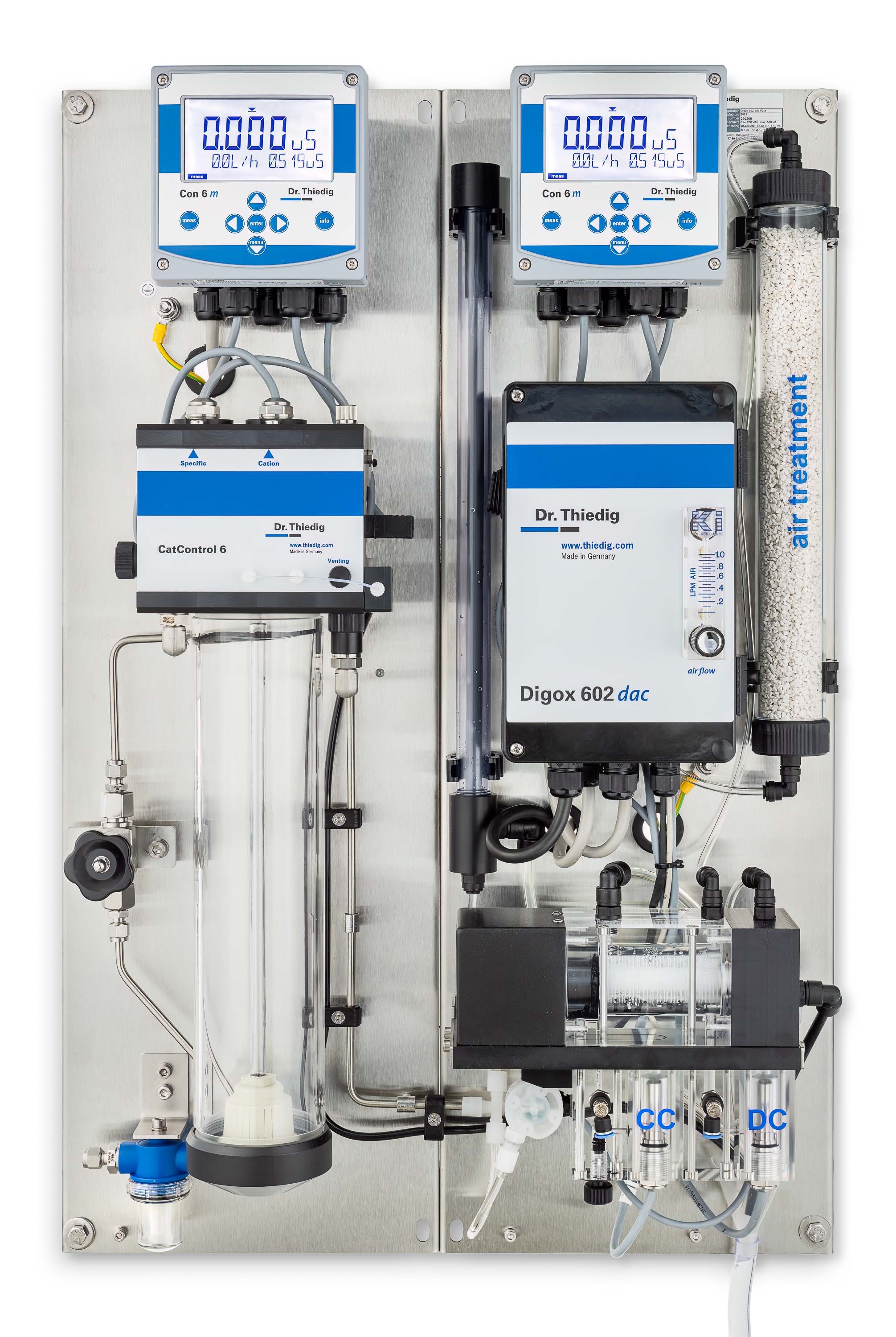
With the Digox 602dac you have a universal measuring instrument at your disposal for this kind of tasks. In the compact design, you have first a double conductivity measuring including a cation filter, automatic venting and pH calculation according to VGB-S006, then a separating operable degassing unit with conductivity measurings before and after degassing. Depending on the efficiency, the degassing can be calculated to 100 %.
It must be distinguished between:
- Specific conductivity which records the sum of all charge carriers and is mainly caused by enriched alkalising agents.
- Acid conductivity
In cation filter, the H+ from the exchanged cations combine with OH- from alkalizing agents to water. The remaining conductivity is determined by the autoprotolysis of the pure water plus the impurities in the form of anions.
To operate a steam turbine, the acid conductivity must not exceed a threshold of typically 0.2 μS/cm.
The following causes for increased conductivity are possible:
unclean piping system, high corrosion conditions
cooling water leakage in the condenser
atmospheric air-in leakage with CO2-impact
organic substances in the boiler feed water - CO2- impact
after heating
- Degassed Cation conductivity
For the shortest possible start-up phase, the acid conductivity must be measured without the influence of the conductivity caused by dissolved CO2. Thus the threshold for operation of the turbine is reached faster.
The dissolved CO2 rises up the conductivity, but does not harm the turbine. Therefore, it is necessary to remove the carbonic acid from the sample and to measure the conductivity again (degassed acid conductivity).
Thus, on one hand, the start-up phase can be significantly reduced. On the other hand, the system can be monitored for organic substances and atmospheric air ingress.
 Download a datasheet